Sunday, October 10, 2010

Simple strategy for slot machines

Faced with the aggressive strategy of the simple slot machine, most players use the strategy of conservative stop loss. In this way, are capable of mixing aggression with caution, and therefore get the best of both.

Strategy Run Game Slots strategy is called to execute the game, because it is hitting a machine unless you leave what you want, this strategy leaves no room for sentimentality or instinct, use only the minimum bets that lets you quickly find the best machines. Run the game is a good option for everyone.

Naked and Pulls Limit Loss Before entering the specific approach of running the game, it is first important to understand two concepts that are central to the strategy; Pulls Naked and limit the loss.

Tire means a nude performance with a round win. A player must determine a slot number of spins on a machine that will last without a victory before considering the cold and go to the next machine.

A loss limit is the percentage of your money you’re willing to lose on a machine before leaving it. Between the number of Pulls Naked and the loss limit, their interests will be protected and not continually put a lot of money after the machine has a good bond.

a privately-owned business services group with its roots in shipping


About Us

Bibby Line Ltd is the shipping division of Bibby Line Group Limited; a privately-owned business-to-business services group with its roots in shipping. Following an aggressive strategy of diversification in the 1980s, Bibby Line Group is now involved in ship owning and operation, shallow water accommodation, offshore oil field services, contract logistics, financial services, memorial parks, employment law and health and safety advisory services and retail.

The company was founded by Liverpool entrepreneur John Bibby in 1807 and has its head office in Duke Street, Liverpool.

Bibby Line has built a strong reputation over 200 years in business for professionalism, integrity and quality and is regarded as the oldest privately owned shipping company in the world. This combined with Bibby’s financial strength allows the shipping division to respond quickly to new opportunities.

Throughout its long and illustrious history, Bibby Line has a record of involvement in almost every aspect of marine industry, having owned, managed or operated all types of vessels and has built an enviable reputation for safe and high quality operations, particularly specialising in niche shipping activities.

With a clear and aggressive strategy, Bibby Line aims to grow, diversify and further strengthen its position in chosen market sectors. It has the resources and particularly committed employees to deliver growth and prosperity to its stakeholders.

Cramerica Runs on Natural Gas

        “This whole move is predicated upon the idea that Washington has at least embraced natural gas, that this cleaner, greener fossil fuel — I know it’s fossil, which puts it in the dog house — will be a part of our energy future. Take Anadarko, Anadarko Petroleum is one of the strongest derivative natural gas plays, one of those I’ve been recommending since January 12th, when it was at $38.33. The stock is now up to $54.40. A 40% increase.

        Even as the price of the commodity has just been crushed.

        If natural gas is going to be part of our energy future, then Anadarko is a fantastic stock to own. And its second quarter, recorded record sales volume, selling 4 million more gallons than the midpoint of Anadarko’s guidance. As well as record drilling, the company was able to run fewer rigs but drill more wells and the cost of wells coming down. Anadarko’s a great growth energy with new discoveries in the Gulf of Mexico and Mississippi, a major new project in Ghana that was approved by their government in July and another project in Algeria that’s expected to start producing oil in 2011.

        The company’s also done a great job of hedging its natural gas 80% of anticipated natural gas volumes, hedged at $4.18 in the summer months. Hey, who would ever thought that was going to be good, right? And more than 75% of its 2010 natural gas volume’s protected with a middle floor of $5.60 and an upper ceiling of $8.25. So, even if natural gas prices don’t bounce back hard, Anadarko’s still in good shape.

        APC

        And it’s not starving for cash, either. Remember it raised $1.3 billion with that secondary offering in May? That was at $45.50. Made a lot of people money. You’re up 20% if you got that offering price. Even, again, natural gas collapsed and they raised another $109 million in debt in June, leaving them with $3.5 billion in cash at the end of the quarter and no debt coming due until 2011.” — CNBC’s Mad Money 8/24/2009

Cramer invited Jim Hackett CEO of Anadarko Petroleum (APC) onto his show to discuss the natural gas industry. As you can tell from Cramer’s lead-in to the interview, he is very high on Anadarko specifically and has been recommending them since January. More generally, he is very interested in discussing the benefits of shifting America’s energy infrastructure to run on natural gas that has been produced here in America instead of continuing to import crude oil from all over the world. He made a compelling case for natural gas being a step in the direction of energy independence, and we can hope that this kind of thinking makes its way to Capital Hill soon.

Looking at Anadarko in particular, we think management is doing an exceptional job of dealing with slumping natural gas prices. As mentioned, APC had the foresight to hedge 80% of their production at $4.18, which seemed low at the time, but this has turned out to be a wise strategy as prices continued to fall. In addition to smart hedging, Anadarko management continues to increase production through the downturn. While other producers are forced to slow down production in hopes that prices will rise in the future, APC’s aggressive strategy makes it one of the best positioned to meet today’s challenges.Mad-Money_8-24

Anadarko has appreciated more than 40% year to date, and is currently Fairly Valued by our methodology. Based on the company’s current EPS and revenue figures, we would expect APC to trade somewhere between $45 and $62. With that in mind, our analysis would obviously become more positive on Anadarko if the price of natural gas starts to recover. This is a very real possibility as the ratio oil to natural gas prices has reached 26.35x, which is the highest it has been since at least 1990. Prices reflect supply and demand of each commodity, but we would expect a reversion to the mean over time.


The chart to the right lists each stock that Cramer talked about on Monday’s Mad Money. Please visit Ockham for a complete recap of Mad Money.

Tight Aggressive Style in Poker

If you’ve read our basic poker article about categorizing your opponents, you should already be aware of the 4 typical playing styles in poker using the following labels:  tight, loose, passive, and aggressive.  In that article, the tight-aggressive strategy was described as the most effective strategy for beating low limit cash games, single table tournaments (SNGs), and low buy-in multi-table tournaments (MTTs).  How do you play a tight-aggressive style?  Let’s break it down.
Playing Tight

The first step towards playing a tight-aggressive style is playing tight. Playing tight means getting involved in less hands and folding more hands preflop.  Probably the biggest mistake that new poker players make is playing too many hands.  Being selective about the hands you play will plug this leak and increase your winnings immediately.

The most important thing that being selective does is it helps you conserve chips by folding bad hands right away and not trying to chase second best hands.  For example, folding hands like Ks8s helps you avoid going broke when your opponent makes an A-high flush to your K-high flush and saves you chips when the flop comes king high and you are facing a stronger kicker.

A lot of the money you win or lose playing poker will occur during hands that don’t go to showdown.  You will save yourself money by simply playing tight and folding marginal hands preflop, instead of folding them after you’ve paid to see the flop and missed it yet again.  Playing a tighter range of hands is also helpful for maximizing your credibility when employing the second part of a tight-aggressive strategy, which is playing aggressive.
Being Aggressive

Being aggressive in poker means constantly being on the attack.  Your main actions are betting, raising and reraising.  You rarely check or call.  You don’t wait for your opponents to act and then react to their actions.  As an aggressive player, you want the other players at the table to be forced to react to your actions.

A basic tenant of poker is that it takes a stronger hand to call a bet than it does to raise.  Therefore, if your hand is good enough to call, it’s definitely good enough to raise.  This forces your opponent to have to make the majority of the difficult decisions.  This is a very important concept to remember when playing a tight-aggressive style.
Why the Tight-Aggressive Style is so Effective

The table image your create when implementing a tight-aggressive style is hard to combat. Your tight hand selection gives your opponents the impression that you only play strong, quality hands.  It also makes your bluffs more effective.  For example, your opponents will more apt to believe you have an overpair on a flop containing all low cards than they would against a looser player.

The aggressive component of the equation makes your hand strength difficult to read.  By playing your strong hands, medium-strength hands, bluffs and draws aggressively by betting and raising, your opponents will have a difficult time putting you on a hand.  If you maintain a uniform bet-size regardless of the strength of your hand, such as 2/3 to 3/4 of the pot, you will be able to further disguise your holdings.
Final Thoughts

The tight-aggressive style is the most important strategy new players should learn when they start playing poker.  It combines the two most effective playing styles of poker and helps new players develop the fundamentals required to excel at poker.  By playing tight, you will generally enter pots with an advantage and win more hands at showdown.  By playing aggressively, you can keep control of the action and force your opponents to make the difficult decisions. The tight-aggressive style is the most optimal strategy for consistently beating low limit cash games and low buy-in SNGs and MTTs, so it’s definitely a style you’ll want to master as soon as possible.

Honda’s Aggressive Strategy: Hybrid Green Technology

Honda’s new president Takanobu Ito has announced that he will draw upon the legacy of Honda’s founder to try to ride the current storm in the auto industry; he will do this while trying to offer an aggressive strategy with its hybrid green technology.

The founder, Soichiro Honda was known for his love of cars as well as his boyish personality; sadly, he passed away in 1991. Ito has stated that Honda is to speed up its hybrid vehicle plans, the next vehicle is to be its CR-Z sporty hybrid, this should be released in February 2010 in Japan.

Honda also has plans for a Hybrid Fit subcompact before the end of 2010. Honda are also in the planning stages of offering a CR-Z for the North American and European markets, but it is not known if there will be hybrid versions for these reasons.

Las Vegas Sands Rethinks Macau VIP Strategy

HONG KONG—Las Vegas Sands Corp.'s Macau unit is taking a second look at how it markets itself to high rollers after last week dismissing its chief executive, Steve Jacobs, who was a key proponent of direct marketing to clients.
 Sands China Ltd., lauded by many analysts for its aggressive strategy of improving profit margins by cutting out middle men known as junkets to bring big spenders to its casinos, will "study the economics" of using intermediaries to bolster business versus marketing directly to VIP players, the company's newly appointed acting chief executive, Mike Leven, told Dow Jones Newswires on Thursday.

"It will be a number of months before we come to a conclusion," said Mr. Leven, who is also chief operating officer at Las Vegas Sands. Sands China is Macau's second-biggest casino operator by market share after Stanley Ho's SJM Holdings Ltd.

Las Vegas Sands's decision to re-examine its strategy in Macau comes amid a whirlwind of change at the Hong Kong-listed unit that has seen its chief executive depart amid rising tensions with Chairman Sheldon Adelson, as well as the appointments of two top executives in less than a week, all while the company struggles to restart a stalled $4 billion expansion project in Macau.

Mr. Adelson said on Las Vegas Sands' second quarter earnings call Wednesday that its Macau unit may pull back its efforts to drive the direct VIP business, despite analysts' estimates that the method is able to deliver double the margins of VIP business facilitated by junkets.

"We are in active discussion right now since we terminated Steve Jacobs about the wisdom of accentuating the effort for direct premium play," said Mr. Adelson.

Junkets, who bring high-spending gamblers to the casinos, issue them credit and collect on debts in exchange for commission. Although junkets do cut into casinos' margins, they are able to drive business volumes and reduce credit risk because they could be more familiar with their clients' financial standing, reducing the chances of bad debt, which is particularly troublesome to recover in China.

As gambling debt isn't recognized in China, there are no legal means for casinos to recover debts owed to them by Chinese players, which account for the majority of their customers.

Sands China has improved the margins on its earnings before interest, taxes, depreciation and amortization to 28.5% in the second quarter from 22.6% in the same period last year under Jacobs' leadership, demonstrating the company's "effort to cultivate the direct VIP business is time well spent," Citigroup analyst Anil Daswani said in a report Thursday.

But the casino operator's new management now wants to make sure its bold strategy to save on junket commission fees hasn't been the company's relationships with these intermediaries, long a powerful force for driving gambling revenue in Macau, the only place in China where casino gambling is legal.

Sands China wants to make sure it doesn't lose valuable junket business to competitors such as Wynn Resorts Ltd.'s Macau unit by alienating these middle men with its strategy, Mr. Adelson said on the call.

The company's strategy reappraisal highlights an evolving debate in Macau over the best way to drive business from high rollers, which have powered Macau's nearly 70% year-on-year growth in gross gambling revenue in the six months ended June 30. VIP play accounted for more than 70% of total revenue for the period, according to analysts.

There are currently 75 active junkets in Macau, the top five of which control about 80% of Macau's VIP market, CLSA analyst Huei Suen Ng said, citing industry sources.

Though Sands China's efforts to drive direct VIP play "should ideally help margins," the strategy could "result in higher balance sheet risk," Morgan Stanley analyst Praveen Choudhary said in a note Thursday.

There are also concerns casino operators can't match junkets' client sourcing abilities: "We all understand the margins are better with direct but the question is if the operator can keep growing that business," said Credit Suisse analyst Gabriel Chan.

Sands, though arguably the most aggressive proponent of driving direct VIP business, isn't the only operator to do so. Wynn Macau, for example, does pursue its own high-end customers, but not in large volumes, according to a person familiar with the situation.

Aggressive Strategy

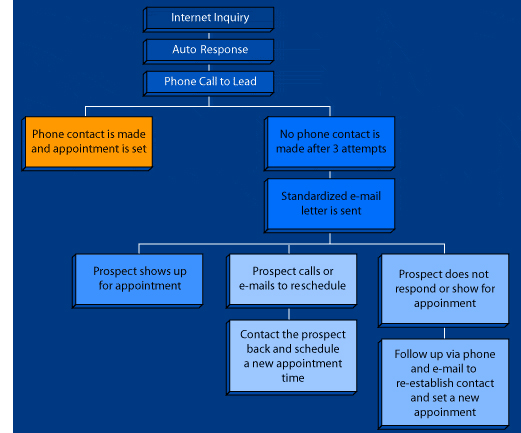
The goal of the aggressive strategy is to skip the initial chitchat. You want to jump straight to the appointment. You will make e-mail and phone contact almost simultaneously. The goal is to reach the prospect by any means necessary as quickly as possible to begin the enrollment process.

Overview of the Follow-Up Process

Below is a flow chart representing the basic steps necessary to effectively follow up on an Internet lead. The process begins when a potential student e-mails a request for information to the school.

To view flow chart click here.

Auto Response
An auto response is an e-mail generated automatically. It goes to the person submitting a request for information from the school. This is the first step in the process, and it acknowledges that you received the prospect's request. Provide your school's phone number in the auto response. Begin selling the value of a one-on-one meeting with an admissions representative at the campus.

Contact Method: Phone
In an aggressive strategy, contact your prospect by phone first. Contact forms generally request both daytime and evening telephone numbers. They should also ask for the best time to call. Use this and other supplied information to guide your follow-up. You should contact the prospect as quickly as possible.

Attempt phone contact at least once in the morning, during the day, and in the evening. Make contact attempts within 12 to 36 hours of receiving the lead. If you get a machine or voicemail system, leave a message. Make sure to leave your name, phone number and the reason for your call. Emphasize that you are responding to their request. This will indicate that the prospect solicited your call. Make sure to suggest 2-3 times during the day when it is easy for them to reach you. Finally, let the person know you will be making additional attempts to contact them. Leave only one voicemail message – on the first attempt. But let them know you'll call back. You do not want the prospect to feel harassed if additional calls from you show up on a caller ID log.

Once you establish telephone contact, work through the admissions process as you would with any other lead. Maintain control of the conversation. Guide the person to schedule a time to visit the school.

Contact Method: E-mail
It's important to realize that some people prefer e-mail to phone communication. You should e-mail a standardized letter to the prospect if you are unable to connect with them on your phone contact attempt. Develop one standard letter for your school and save it as a template. This will allow anybody who is aggressively working Internet leads to access and use it.

Prior to sending an e-mail as part of your aggressive strategy, set aside time for an appointment for the following day at the latest time you have available. If they indicated their daytime availability in their e-mail, you may also schedule the visit during that time. Assume that the prospect will be available and willing to meet during the time you have set aside.

Your standardized e-mail letter for this strategy should:

   1. Be customized to the information the prospect provided on the contact form. Make sure to use the prospect's name. Mention some specific information supplied in the initial request, such as program of interest.
   2. Have a subject line that makes your e-mail stand out. You don't want it viewed as spam or junk e-mail. An example of a good subject line is "Jim, your appointment has been scheduled."
   3. Let them know that you have scheduled a time for a one-on-one meeting at the school. State the precise time you have set aside in terms of quarter hours, e.g. 10:45 a.m., 4:15 p.m. or 6:45 p.m., and provide the meeting location and specific directions.
   4. Focus on the benefits of your school. You want to speak in language that assumes their desire for an appointment. State that you can answer all of their questions and discuss their opportunities during this visit.
   5. Use proper grammar and spelling. Most e-mail programs have grammar and spell-check functions. Use these before sending the e-mail message, but not as a substitute for careful proofreading!
   6. Be as concise as possible so you won't lose the prospect's interest.

Though you may encounter a small percentage of people who feel you are being presumptuous, and a few who never actually see this e-mail, most people will call you to either confirm or reschedule the appointment. Some actually just show up. Either way, this aggressive strategy generally results in a phone call and/or appointment. A common result of the aggressive strategy is:
•     10% show up for the appointment
•     35% do not respond and need to be pursued
•     15% call to confirm
•     40% call to reschedule

If the Prospect Does Not Show Up or Call
You may find yourself into a situation where the prospect simply ignores the scheduled appointment. To follow up with no-shows, call immediately, concerned that they did not make it. Whether you leave a message or talk to them directly, make sure to express concern. "Jim, I was concerned when you did not show up for your appointment … I hope everything is alright."

In most cases, prospects will claim that they did not receive the e-mail. In this case, apologize for assuming that they checked their e-mail daily and move forward with rescheduling the appointment. If you cannot reach them by phone, send an e-mail.

Now that you've seen 3 different strategies, let's move on. The next section will address the different types of Internet leads and the steps of the sales process. We will also address frequently asked questions and share testimonials from our clients.

When you finish reading the next 3 sections, we'll ask you to take a quiz on what you've just learned and fill out our short survey to give us feedback on the site.